This year I have taken a bit of a back seat as a volunteer on the Rutland Osprey Project. Rather than book up for a regular fortnightly afternoon turn of duty, I decided to hold off, and just offer to fill in when there were gaps in the roster. This would give me the opportunity to enjoy being present at different times of day.
On this occasion, pal John had been rostered for an evening shift (17h00 to 20h00) on his own and so I put my name down to be his sidekick for the evening.
On the way to pick up John at 14h30, I passed by my Little Owl Site No.02 and found the male owl roosting in the remains of the roof.
 |
| Little Owl (Athene noctua) (male) - my Site No.02 |
Having picked up John, we set off via our usual route. The first owl we saw was at my Site No.37. It took a while before we noticed that there were two birds there - only the second time we have seen a pair here, and we missed seeing the pair the first time until we looked at the photos!
 |
| Little Owls (Athene noctua) - my Site No.37 |
At my Site No.34, an owl was seen roosting at the foot of a hedge. It is reasonable to assume that this was the male of the pair here.
 |
| Little Owl (Athene noctua) (male) - my Site No.34 |
No further owls were seen before we reached Rutland Water.
On arrival we checked in at the Visitor Centre and set off for Waderscrape Hide, where the Osprey monitoring takes place, and where we look after the visitors who come to see the Ospreys. The hide is a comfortable one, with good (but distant) views of the Osprey nest and there is a large screen which gives close-up views via a nest-cam.On the way to the hide I photographed a couple of beetles, just to try and keep my hand in at macro-photography. |
| unidentified beetle species - Rutland Water, Lyndon Reserve |
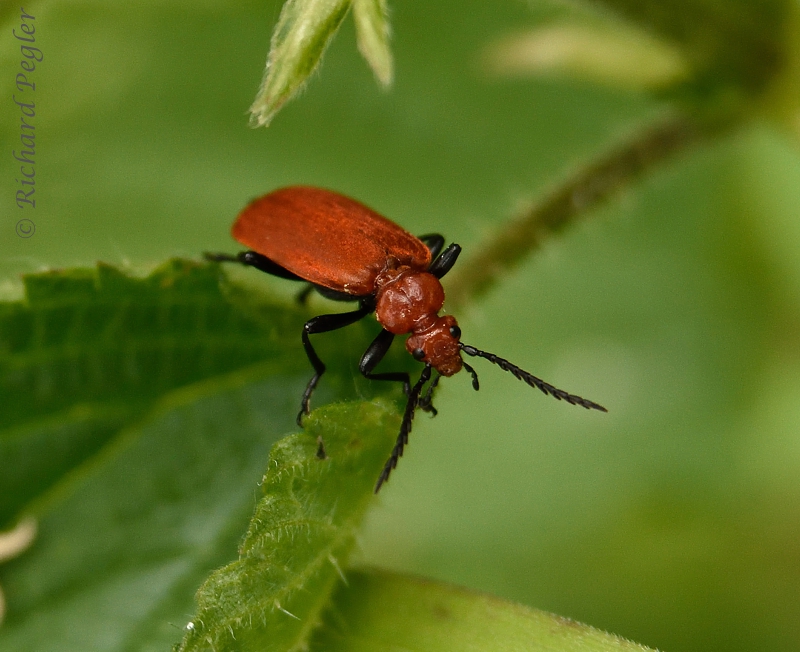 |
| Cardinal Beetle (Pyrochroa serraticornis) - Rutland Water, Lyndon Reserve |
We arrived at Waderscrape Hide to be told by the people that we were taking over from that Sedge Warblers had been showing well, as had Water Vole, and that the people on duty before them had also seen a Water Rail.
Immediately the Sedge Warblers made their presence known, and I found myself distracted from the Ospreys by these delightful little birds. I'm not sure if it was just the one bird that was wearing a bracelet, or if there had been a mass ringing session, as all my photos show a ringed bird!
 |
| Sedge Warbler (Acrocephalus schoenobaenus) - Rutland Water, Lyndon Reserve |
Osprey action was a little limited on this occasion as the female Osprey was busy incubating eggs at that time and the male Osprey went off fishing just before our shift started. From memory, he was gone a good hour and a half. In spite of the fine weather our last visitor left after about an hour, so we amused ourselves by watching the other wildlife action.
I can say, with confidence, that I saw more Water Vole action in that one shift than I have seen in total over the whole of my ten years as volunteer on the Osprey Project. There were at least four voles, and we saw two altercations between voles, one of which went on for a minute or two and seemed to be particularly violent. Sadly, I was not able to capture the punch-ups as the action was so fast and most of the time took place in the thick of the reed-bed, its progress being only visible by the crashing disturbance of the reeds which was accompanied by squeals.
Here are a few images from the evening.
 |
| Water Vole (Arvicola amphibius) - Rutland Water, Lyndon Reserve |
When the male Osprey returned he took a fish to the 'T' perch that is close to the nest. He spent a long time consuming his share before dropping the remains of the fish into the water, leaving the female to go hungry. It seems that he had been making a bit of a habit of this lately - it would be interesting to know why!
I was hoping for some flight shot opportunities but the only birds to pass anything like close enough were a pair of Greylag Geese.
 |
| Greylag Geese (Anser anser) - Rutland Water, Lyndon Reserve |
It was around 18h50 when a Water Rail suddenly appeared from the reeds and flew across in front of the hide. I was totally unprepared for the shot, and it was into the sun anyway. I was better prepared when a second bird appeared from the same place, but passed in front of the hide on foot, occasionally emerging from behind the reeds in front of the hide.
 |
| Water Rail (Rallus aquaticus) - Rutland Water, Lyndon Reserve |
Although it had been sunny for much of the afternoon, the air had been rather misty, making distance viewing difficult. As the sun dropped the difficulty increased to the point that we could no longer see what was going on with the Ospreys through the 'scopes - it was just a blaze of bright light - so we finished our shift a few minutes early, there being no action to note.
On our way back to the car, John remarked that he felt cold - the significance of this was lost on me at the time, although I did think that he'd been acting a little disinterested during the evening. John rarely ever feels the cold. A call from John on the Saturday to say that he'd returned home on the Thursday to find he was running a temperature of 103 degrees F suddenly made sense of the situation.
As we approached my Little Owl Site No.41 I could see the silhouette of an owl poking out from the stump of what used to be the nest tree. I pulled up alongside and took ages to find the owl in the near dark conditions. It took me even longer to find it through the viewfinder and I don't think that John, who was on the owl's side of the car, ever did find it?
 |
| Little Owl (Athene noctua) - my Site No.41 |
It had been a super evening out, but I'm sorry to say that John is still not well, and is staying close to home. I hope that you're better soon, John.
FOOTNOTE
The day after we were on duty, the first of the Osprey chicks hatched out (12th May). A second chick hatched out the following day. Sadly, one of these two chicks died in the night of 14th May - possibly as a result of an accidental injury inflicted by the female Osprey. The third chick hatched on 16th May, and both remaining chicks were doing well. The fourth hatching was on 18th May, but but the chick didn't make it through the night. Four eggs is a relatively unusual situation, and raising all four was never going to be easy. The success rate at Rutland Water has been very good in the past, and whilst upsetting, this is not a major setback. If the remaining two chicks can be taken through to a successful fledging it will still be a positive result. We wish these tiny chicks a long and healthy future.