This is the third part of my account of our adventures when Canadian friends David and Miriam came to stay. The first two parts of this account can be found here, and here.
Saturday, 1st August
We woke to a promising looking day with some sun around so, having had a good breakfast and purchased sandwiches for a picnic lunch, we set off northwards.
Our first stop was at Dulsie Bridge, where we took a walk beside the River Findhorn in the hope of finding Dipper - a bird that was proving to be uncharacteristically elusive for these parts! It was a pleasant interlude, but no Dipper was seen.
We departed Dulsie and headed west towards Drynachan. A comfort stop along the road resulted in me getting a quickly grabbed record shot of a Common Hawker dragonfly. It flew whilst I was adjusting my camera settings and then settled on my chest! I didn't get another chance as it then disappeared.
 |
| Common Hawker (Aeshna juncea) (immature male) - near Dulsie |
Further down the road we found a rather tatty fritillary butterfly, subsequently identified as a Dark Green Fritillary, although the underside didn't show any signs of a green colouration!
 |
| Dark Green Fritillary (Argynnis aglaja) - near Dulsie |
We stopped for a wander down to the river at Drynachan - no Dipper, but several Song and Mistle Thrush were there.
 |
| Mistle Thrush (Turdus viscivorus) - Drynachan |
 |
| Song Thrush (Turdus philomelus) - Drynachan |
After this, we headed northward up over the moors, on to Cawdor, and then to the Moray coast at Findhorn. It was time for our picnic so we sat in the car behind the sand dunes, where were were entertained by a Hooded Crow feeding its young, and a gull that was trying to get in on the action. It wasn't until a couple of weeks ago, when processing my photos, that I realised that we'd been looking at a Yellow-legged Gull - a rarity this far north! - UPDATE: The identity of this gull has been called into question. Whilst one of Canada's leading gull experts has confirmed this as a YLG on the basis of colouration and the two small 'mirrors' on the primaries (a LBBG has just one on primary 10), Scottish authorities are suggesting it is a Lesser Black-backed Gull. Our money's currently still on YLG!
 |
| Hooded Crow (Corvus corone cornix) - Findhorn |
|
|
 |
| Yellow-legged Gull (Larus cachinnans) - Findhorn |
After lunch, we had a walk over the dunes and round the spit, seeing a few seals in the water, and this same gull (same dirty mark on neck) on the shoreline. After refreshments in the chandlery café we set off for Burghead.
At Burghead, we visited the harbour area first. Here, David was happy to pick up Rock Pipit, and we had the unexpected sight of a Pink-footed Goose in the harbour!
 |
| Rock Pipit (Anthus petrosus) - Burghead harbour |
 |
| Pink-footed Goose (Anser brachyrhynchus) - Burghead harbour |
A visit to the other side of the headland didn't yield anything of moment, and so we set off for the nearby coastal village of Hopeman. It was starting to rain, and so we spent a while in the harbourside Footprints Gallery and Craft Shop. Whilst we were in there, the rain became torrential for a while.
When the rain abated, we went over to the north side of the harbour and, while we were scanning the area, a small group of Turnstone arrived on the rocks below the wall. These were exhibiting a wide range of plumage variations. It was the one with the largely white head (full summer plumage) that I found most attractive.
 |
| Turnstone (Arenaria interpres) - Hopeman |
After Hopeman, we visited the Lossie estuary at Lossiemouth, but the tide was in, and nothing of any great interest was seen.
We returned to Grantown via Lochindorb where we saw a couple of Ospreys flying high as we arrived, but not much else. It was then back to the Grant Arms for dinner, followed by an early night.
Sunday, 2nd August
David and Miriam had booked another day out with John Poyner, and I was looking forward to taking a day of rest - although it didn't work out like that!
I started with a visit to my favourite location near Nethybridge, in the hope of finding Short-eared Owls. I didn't, but although nothing desperately exciting was seen, if I'd have been at home, what I did see would have been exciting enough!
Whilst sitting in my car, Meadow Pipits were landing on the wires near me. I include the second image for its comic value!
 |
| Meadow Pipit (Anthus pratensis) - near Nethybridge |
Whilst sitting there, I noticed a yellow bird on a distant fence line beside the conifer woodland, but I couldn't get a good enough view to identify it. However, I did manage to identify the Redstarts that were also on the same fence line.
 |
| Redstart (Phoenicurus phoenicurus) (male) - near Nethybridge |
I confess, here, to breaking my usual rule which is to not get out of the car here. However, as there was not anything sensitive visible at the time, I took a wander along the road to try and get closer views of the Redstarts. I only halved the distance between the car and the woodland but it did allow me better views of a Redstart and a Spotted Flycatcher.
 |
| Redstart (Phoenicurus phoenicurus) (juvenile) - near Nethybridge |
 |
| Spotted Flycatcher (Muscicapa striata) - near Nethybridge |
For some reason I decided to leave the area, but now wish I hadn't as, on reflection, I'd probably have had a more relaxing and productive time if I had. As I left, I passed an area of 'clear-fell' where there were a number of piles of severed branches. We'd previously commented that these should have been real bird magnets, but they hadn't been - that is, until this day! Sadly there was nowhere I could park to observe the birds and I did not want to upset the estate staff by obstructing the road so I had to make a slow pass. This resulted in a few 'don't knows' - possibly the most in one session since my early birding days! Here's my best attempt at a few!
I think that this is probably a juvenile Redstart.
 |
| probable Redstart (Phoenicurus phoenicurus) (juvenile) - near Nethybridge |
This next one is possibly a Wheatear - but maybe not!
 |
| possible Wheatear (Oenanthe oenanthe) - near Nethybridge |
I've no ideas at all on this next one - unless it's another young Redstart!
 |
| ? - near Nethybridge |
If you've got any ideas on the above, please let me know! The one on the left in the next image I think is a Willow Warbler, but the one on the right I'm sure of, however!
 |
| probable Willow Warbler (Philoscopus trochilus) + Grey Wagtail (Motacilla cinerea) - near Nethybridge |
One of the reasons for my decision to depart was to try and find more dragonflies and butterflies on the road between Dulsie and Drynachan. I soon gave up on this, however, due to the huge numbers of flies (no, not midges) that made a total nuisance of themselves. Instead, I went up onto the moors above Drynachan. Here, at a small roadside boggy pond I saw what I believed afterwards was the rare Azure Hawker dragonfly. The habitat (open moorland at an altitude of around 300 metres) and behaviour (staying close to the ground, flying between reeds, landing on the ground as soon as the sun went in) fitted, but I've started to doubt my ID of this and wonder if it was just a Common Hawker. I'd have persevered with trying for photos, but it coupled up with another dragonfly and sped away across the moorland into the far distance. I'm left with a couple of images that probably don't even pass as record shots. The first is a screen grab of the location, taken from Google Earth
 |
| location of possible Azure Hawker sighting |
 |
| possible Azure Hawker (Aeshna caerulea) (male) - near Drynachan |
After this brief session I headed back towards Grantown, making a few diversions en-route. At one location I went to check for Red-throated Diver at Black Loch, above Dava, but drew a blank. However, as I returned to my car in the now dull day a small flock of Redpoll flew into a nearby tree.
 |
| Lesser Redpoll (Carduelis cabaret) - by Black Loch |
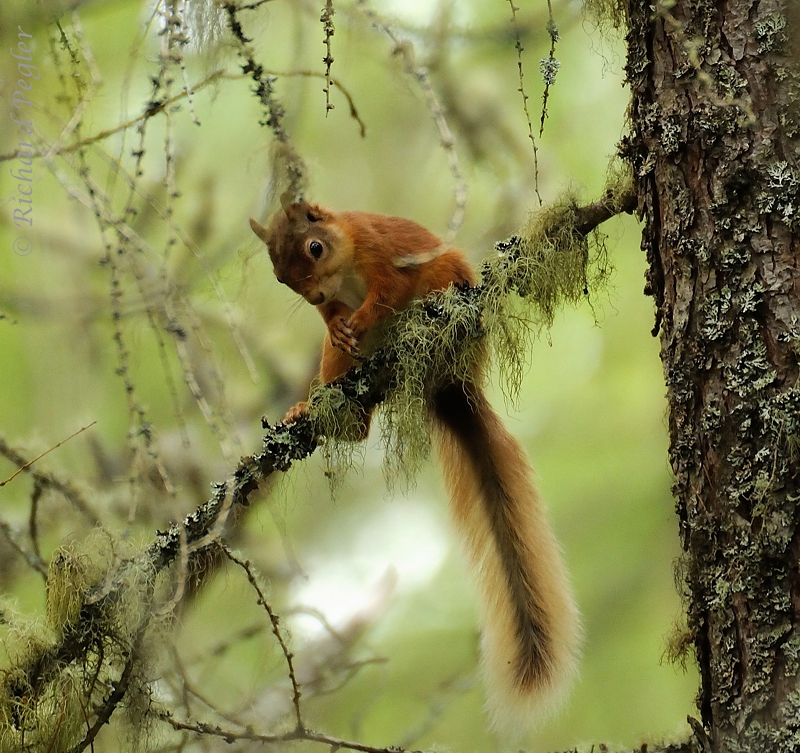
A further diversion on the way back yielded nothing but a Red Squirrel.  |
| Red Squirrel (Sciurus vulgaris) - near Grantown on Spey |
I returned to the hotel, feeling exceedingly tired and, as we'd arranged an evening out, went to my room for a nap before dinner.
After dinner we were to meet up with a gentleman who is something of an unsung hero as far as wildlife is concerned. Allan Bantick has recently been awarded an OBE for his services to wildlife. His current projects include Badgers, Beavers, Goldeneye, and Red Squirrel. He's led a fascinating life, and has, in relatively recent years, enjoyed the company of Royalty, wildlife celebrities, and even the Pope! Miriam was feeling unwell that evening and retired to her room just before the end of dinner, so it was just David and I who went off to meet Allan in order to see Badgers.
Having met up as arranged at the Boat Hotel, Allan drove us to a gateway where we climbed over a five-bar gate to take the walk that led to his Badger hide. Alan was a delightful and fascinating host, and his set-up is impressive, to say the least. We learnt a lot about Badgers, and only had to wait a few minutes before the first Badger emerged. By the end of an hour, we'd seen at least four Badgers (simultaneously) but probably six. Sadly, my camera does not perform well in low light, so these are the best that I could manage. |
| Badger (Meles meles) - near Boat of Garten |
David and I agreed that this had been one of the most memorable wildlife experiences in our lives, and I take this opportunity to thank Allan for his generosity in showing us these wonderful creatures. If you're in the Speyside area and want to see Badgers, do contact Allan - details on the Cairngorm Wildlife website.
It was a very happy couple of guys that returned to Grantown on Spey that night - somewhat earlier than we'd allowed for!
Monday, 3rd August
This was our last day in Scotland as we would be returning to England the following day. I think we were all a little weary by now as we'd been virtually wall-to-wall birding for the past eleven days, and Miriam was still under the weather, so we'd agreed to be a little later for breakfast. We were on our way again at around 09h00 with our first stop being at Dulnain Bridge. A significant part of this day would be spent searching for the elusive Dippers, but we dipped on this species once more here.
The back road to Carrbridge didn't produce any excitement, and Carrbridge itself was also a Dipper-free zone when we arrived, although I felt obliged to take a shot of the scenic bridge here, before we drove over it - only kidding!
 |
| Carrbridge - without Dippers |
From here we continued to Avielochan, to the north of Aviemore. As we passed down the road to the hide, a Slavonian Grebe was just off shore, and the light wasn't too bad for photography.
 |
| Slavonian Grebe (Podiceps auritus) - Avielochan |
The weather had started off quite warm and, I'm delighted to say, continued that way. I'm usually lucky with weather when I go on holiday, but up until now this trip had been cold and windy and a little wet at times - a pity it waited until the last day to buck up! At the hide we relaxed and watched the numerous birds, but little exciting was seen until an Osprey appeared (unringed), being harassed by a gull. This bird clearly demonstrated how such birds of prey moult single matched pairs of feathers at a time. |
| Little Grebe (Tachybaptus ruficollis) - Avielochan |
 |
| Goldeneye (Bucephala clangula) - Avielochan |
 |
| Osprey (Pandion haliaetus) - Avielochan |
A stop at Feshiebridge produced a brief and distant sighting of a Dipper, but it headed off before David and Miriam could reach my position. Then the tubers appeared, having great fun, but creating all sorts of mayhem as far as the birds were concerned.We then headed up Glenfeshie to see what we could find. The answer was virtually nothing, so we stopped off at Uath Lochans for a lunch break in the car park before taking a walk. I'd intended that we take a walk round one of the trails, but there was flooding, with much of the boardwalk area under a significant amount of water.We'd not gone far before I spotted a large beetle on the trail. Not wanting it to get squished, I picked it up, but accidentally dropped it again. I just couldn't believe what I saw when it landed on its back! Sadly we were in shade and I didn't manage to get a good image. |
| Dung Beetle (Geotrupes sp.) - Uath Lochans |
Further on, we came out of the trees, and by a very small pond I tried to photograph a Large Red Damselfly. Unfortunately it refused to move to a more photogenic location, and I did not want to spend too much time at the task in deference to David and Miriam.
 |
| Large Red Damselfly (Pyrrhosoma nymphula) (male) - Uath Lochans |
Along the path I found a fly which had landed on a sheet of tinfoil with such force that it had dented it! |
| Common Pondskater (Gerris lacustris) - Uath Lochans |
OK, so I was kidding again!Soon after this we turned back, as the bridge over a stream was under water!
We were foiled from having coffee and cake at The Potting Shed at Inshriach Nurseries as it was closed on a Monday - they're missing a trick, being closed on a Bank Holiday Monday. We tried for Dipper at Tromie Bridge, and again at Feshiebridge, but the tubers were still at it so, at David's request, we returned to Avielochan.
Nothing new was seen, but I did take a photo of a distant Slavonian Grebe and a Little Grebe with a large (for a small grebe!) fish.
 |
| Slavonian Grebe (Podiceps auritus) (adult + juvenile)- Avielochan |
 |
| Greylag Goose (Anser anser) - Avielochan |
 |
| Little Grebe (Tachybaptus ruficollis) - Avielochan |
Not being used to warm weather, we seemed to tire quickly that day, and were back at the Grant Arms quite early. I went for another much-needed nap!
It was a very enjoyable last dinner that night, and David and I rounded it off with a coffee in the bar afterwards. The following morning we would be leaving directly after breakfast.
The final part of our friends' visit will feature in my next post. Until then, thank you for dropping by.


 For a number of years now, we've been fortunate enough to have Lesser Redpolls visiting our garden each winter. Their numbers vary considerably, with small flocks of 8 birds being recorded several times.