Leaderboard
728x15
Showing posts with label Warbler Sedge. Show all posts

A Morning at Rutland Water - on Saturday 27th May, 2017

On the bank holiday Saturday I was booked for a turn of monitoring duty from 09h00 until 13h00 on the Rutland Osprey Project. As it was expected to be rather busy with visitors, I was extremely grateful that someone volunteered to accompany me for the morning - thank you, Linda!

As it takes around half an hour (allowing for distractions) to get from the car park to the hide from which the monitoring takes place, I set off from home just before 06h30 so that I could take in some of the more promising parts of my usual owling route there.

I saw two Little Owls at my Site No.41, but didn't get any shots of them.

A Little Owl was seen at Site No.23, for the first time since January.

Little Owl (Athene noctua) - my Site No.23
Arriving at my LO Site No.34, I eventually spotted one of the owls further down the field, so turned the car round and drove back down the road to get a shot.

Little Owl (Athene noctua) - my Site No.34
I had no further owl sightings before arriving at the Lyndon Visitor Centre, Rutland Water. Here I unloaded 'The Beast' before setting off. Let me introduce you to 'The Beast'.

'The Beast'
'The Beast', known to some as 'Rick's Lunch Box', has only recently been put into service, following a paint job. It consists of a modified fishing trolley, on which is mounted a recycled recycling box. The box, given to me by a kind friend, has been modified with a fixed internal padded compartment in the top and on one side (the near side in the photo) that my camera fits snugly in. The idea is that the camera can be quickly dropped in if it starts to rain. There is enough room in the bottom of the box for warm clothing, waterproof clothing, drinks, etc. My insulated picnic bag sits comfortably in the other side of the box next to the camera compartment. As I found on my visit to Whixall Moss, the box can also serve as a seat!

On my walk to Waderscrape Hide (from which we do the monitoring) I was keeping my eyes open for dragonflies. However, I was delighted to find a Small Copper butterfly in the field adjacent to the path. It stayed distant, so these are heavily cropped images taken with the lens at full 500mm zoom.


Small Copper (Lycaena phlaeas) - Rutland Water, Lyndon Reserve
I saw many Chimney Sweeper day-flying moths in the meadow beside the path. 

Chimney Sweeper (Odezia atrata) - Rutland Water, Lyndon Reserve
I had a bit of a surprise as I entered Tufted Duck hide. The hide was empty, but a shutter was open, and through it there was a close-up Yellow Wagtail. If the shutter had been closed, opening it would have frightened the bird away. It is not often that I see this species - let alone get so close!


Yellow Wagtail (Motacilla flava) (female) - Rutland Water, Lyndon Reserve
On reaching Waderscrape hide, it soon became apparent why I hadn't been seeing many damselflies - the Reed Buntings were snaffling them as soon as they emerged!

Reed Bunting (Emberiza schoeniclus) (male) - Rutland Water, Lyndon Reserve
The female of the species was also showing frequently, if not 'showing well'.


Reed Bunting (Emberiza schoeniclus) (male) - Rutland Water, Lyndon Reserve
Even more prominent than the Reed Buntings were the Sedge Warblers. In my last post which featured this species at Rutland Water, I stated that I was not sure whether I'd been photographing the same individual all the time, or whether there was a profusion of ringed Sedge Warblers. This caused me to keep my eyes open on this occasion, and I'm sad to report that it was almost impossible to find a passerine that hadn't been ringed. 


Sedge Warbler (Acrocephalus schoenobaenus) - Rutland Water, Lyndon Reserve
Water Rail were seen a few times, but not photographed, and Water Vole was seen just the once by Linda - I only saw the wake afterwards!

The Ospreys were not very active, just taking the occasional joy flight around the bay, but staying very distant.

Osprey (Pandion haliaetus) (male) - Rutland Water, Lyndon Reserve
In the event, a band of very heavy rain passed through, and visitor numbers were down on those expected, so we weren't kept quite so busy as expected. 

At the end of my shift I wandered back to the Visitor Centre, where I treated myself to an ice cream and took a couple of shots of the damselflies outside the centre, before setting off on my travels.

Large Red Damselfly (Pyrrhosoma nymphula) (male) - Rutland Water, Lyndon Reserve
I had a short spell at Ketton Quarry, but it had got windy and cloudy, so little was seen and I didn't stay long but headed homeward.

As I passed Site No.41, one of the Little Owls was out, in the remains of its nest tree.

Little Owl (Athene noctua) - my Site No.41
Thus ended a day with a very enjoyable shift at Rutland Water. Thank you, Linda, for your company on the shift.

I'm not sure what, and when, my next post will be, but suspect that dragonflies will feature again! 

Thank you for dropping by.


A Turn Of Duty - on Thursday 11th May, 2017

This year I have taken a bit of a back seat as a volunteer on the Rutland Osprey Project. Rather than book up for a regular fortnightly afternoon turn of duty, I decided to hold off, and just offer to fill in when there were gaps in the roster. This would give me the opportunity to enjoy being present at different times of day.

On this occasion, pal John had been rostered for an evening shift (17h00 to 20h00) on his own and so I put my name down to be his sidekick for the evening. 

On the way to pick up John at 14h30, I passed by my Little Owl  Site No.02 and found the male owl roosting in the remains of the roof.

Little Owl (Athene noctua) (male) - my Site No.02
Having picked up John, we set off via our usual route. The first owl we saw was at my Site No.37. It took a while before we noticed that there were two birds there - only the second time we have seen a pair here, and we missed seeing the pair the first time until we looked at the photos!

Little Owls (Athene noctua) - my Site No.37
At my Site No.34, an owl was seen roosting at the foot of a hedge. It is reasonable to assume that this was the male of the pair here.

Little Owl (Athene noctua) (male) - my Site No.34
No further owls were seen before we reached Rutland Water. 

On arrival we checked in at the Visitor Centre and set off for Waderscrape Hide, where the Osprey monitoring takes place, and where we look after the visitors who come to see the Ospreys. The hide is a comfortable one, with good (but distant) views of the Osprey nest and there is a large screen which gives close-up views via a nest-cam.

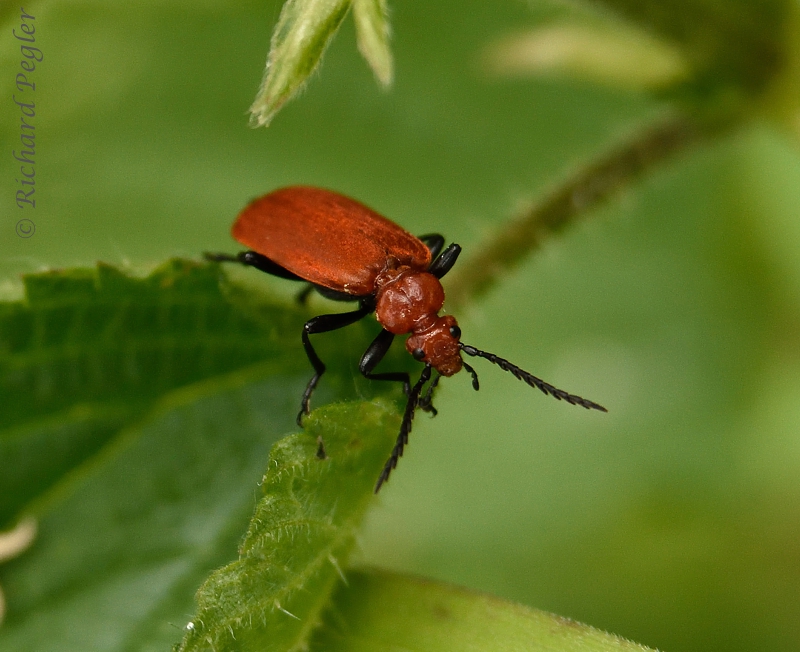
On the way to the hide I photographed a couple of beetles, just to try and keep my hand in at macro-photography.

unidentified beetle species - Rutland Water, Lyndon Reserve
Cardinal Beetle (Pyrochroa serraticornis) - Rutland Water, Lyndon Reserve
We arrived at Waderscrape Hide to be told by the people that we were taking over from that Sedge Warblers had been showing well, as had Water Vole, and that the people on duty before them had also seen a Water Rail.

Immediately the Sedge Warblers made their presence known, and I found myself distracted from the Ospreys by these delightful little birds. I'm not sure if it was just the one bird that was wearing a bracelet, or if there had been a mass ringing session, as all my photos show a ringed bird!


Sedge Warbler (Acrocephalus schoenobaenus) - Rutland Water, Lyndon Reserve
Osprey action was a little limited on this occasion as the female Osprey was busy incubating eggs at that time and the male Osprey went off fishing just before our shift started. From memory, he was gone a good hour and a half. In spite of the fine weather our last visitor left after about an hour, so we amused ourselves by watching the other wildlife action. 

I can say, with confidence, that I saw more Water Vole action in that one shift than I have seen in total over the whole of my ten years as volunteer on the Osprey Project. There were at least four voles, and we saw two altercations between voles, one of which went on for a minute or two and seemed to be particularly violent. Sadly, I was not able to capture the punch-ups as the action was so fast and most of the time took place in the thick of the reed-bed, its progress being only visible by the crashing disturbance of the reeds which was accompanied by squeals. 

Here are a few images from the evening.


Water Vole (Arvicola amphibius) - Rutland Water, Lyndon Reserve
When the male Osprey returned he took a fish to the 'T' perch that is close to the nest. He spent a long time consuming his share before dropping the remains of the fish into the water, leaving the female to go hungry. It seems that he had been making a bit of a habit of this lately - it would be interesting to know why!

I was hoping for some flight shot opportunities but the only birds to pass anything like close enough were a pair of Greylag Geese.


Greylag Geese (Anser anser) - Rutland Water, Lyndon Reserve
It was around 18h50 when a Water Rail suddenly appeared from the reeds and flew across in front of the hide. I was totally unprepared for the shot, and it was into the sun anyway. I was better prepared when a second bird appeared from the same place, but passed in front of the hide on foot, occasionally emerging from behind the reeds in front of the hide. 


Water Rail (Rallus aquaticus)  - Rutland Water, Lyndon Reserve
Although it had been sunny for much of the afternoon, the air had been rather misty, making distance viewing difficult. As the sun dropped the difficulty increased to the point that we could no longer see what was going on with the Ospreys through the 'scopes - it was just a blaze of bright light - so we finished our shift a few minutes early, there being no action to note.

On our way back to the car, John remarked that he felt cold - the significance of this was lost on me at the time, although I did think that he'd been acting a little disinterested during the evening. John rarely ever feels the cold. A call from John on the Saturday to say that he'd returned home on the Thursday to find he was running a temperature of 103 degrees F suddenly made sense of the situation.

As we approached my Little Owl Site No.41 I could see the silhouette of an owl poking out from the stump of what used to be the nest tree. I pulled up alongside and took ages to find the owl in the near dark conditions. It took me even longer to find it through the viewfinder and I don't think that John, who was on the owl's side of the car, ever did find it? 


Little Owl (Athene noctua) - my Site No.41
It had been a super evening out, but I'm sorry to say that John is still not well, and is staying close to home. I hope that you're better soon, John.

FOOTNOTE

The day after we were on duty, the first of the Osprey chicks hatched out (12th May). A second chick hatched out the following day. Sadly, one of these two chicks died in the night of 14th May - possibly as a result of an accidental injury inflicted by the female Osprey. The third chick hatched on 16th May, and both remaining chicks were doing well. The fourth hatching was on 18th May, but but the chick didn't make it through the night. Four eggs is a relatively unusual situation, and raising all four was never going to be easy. The success rate at Rutland Water has been very good in the past, and whilst upsetting, this is not a major setback. If the remaining two chicks can be taken through to a successful fledging it will still be a positive result. We wish these tiny chicks a long and healthy future.

Other Birds - a mop up, to end of September, 2015

I've been posting a little sporadically over the past six months, and there have been many outings resulting in images that I've never posted on my blog. I'm relatively up to date with the owls, but there are many 'other birds' from that period that have not made it onto my blog, so here are some of them.

Longmoor Lake on 2nd May, 2015

I'm a member of the Peter Williams Naturalists Club, and one of our members (Rhys Dandy) led a club visit to this location. The weather was not that kind to us as it was dull, cold, and windy, but it was an excellent visit and Rhys turned up some gems for us. The area round Longmoor Lake has relatively recently been planted as The Queen Elizabeth II Jubilee Woodland - it's easier to say Longmoor Lake - and the tree protectors did rather detract from the photography. There were a few Wheatear around at the time, but the real stars for me were the Whinchat.

Wheatear (Oenanthe oenanthe) (male) - Longmoor Lake


Whinchat (Saxicola rubetra) (male) - Longmoor Lake
Undisclosed Site on 4th May, 2015

A visit to my Little Owl Site No.49 resulted in the sighting of a drake Mandarin. I subsequently came to the conclusion that the Mandarins were nesting in the same tree as the LOs!


Mandarin Duck (Aix galericulata) (male) - undisclosed site
Now follows a series from Rutland Water, most of which were taken whilst on volunteer duty on the Osprey Project with pal John, or on my way to or from a spell of duty.

Rutland Water on 7th May, 2015

On my way down to start my turn of duty (John was to arrive later) I noticed my first Yellow Wagtail of the year on the path ahead of me. It flew up unto a tree as I approached and, because of the overall colouration of the tree, I found it quite hard to pick up again.

Yellow Wagtail (Motacilla flava) (male) - Rutland Water Lyndon Reserve
Fortunately it returned to the path and proved to be relatively confiding. I subsequently found out that this bird was ringed as a juvenile at Abbotsbury Swannery, Dorset UK, on 11th September, 2013.


Yellow Wagtail (Motacilla flava) (male) - Rutland Water Lyndon Reserve
Here are some of the other birds from that day - firstly some from when we were on duty. Although they Osprey images are not good, I was pleased to catch a sequence of a bird lifting out of the water.


Tufted Duck (Aythya fuligula) (female) - Rutland Water Lyndon Reserve


Osprey (Pandion haliaetus) (male 33(11)) - Rutland Water Lyndon Reserve
On our way back to the car park at the end of our shift we called into Tufted Duck Hide to see if the Otters were showing - they weren't, but I took some shots of a GC Grebe. OK, so these might be dirt-common, but I think that they are wonderful birds!

Great Crested Grebe (Podiceps cristatus) - Rutland Water Lyndon Reserve
As we approached the car park, a Chiffchaff seemed to be collecting nesting material.


Chiffchaff  (Phylloscopus collybita) - Rutland Water Lyndon Reserve
Rutland Water on 13th May, 2015

We applauded the female Mallard that had 11 chicks in her charge. I wondered whether she was looking after some for someone else. On a more sombre note, I wondered how many of these chicks would survive to adulthood. 

Mallard (Anas platyrhynchos) - Rutland Water Lyndon Reserve
 Here are a few more from that day.

Common Tern (Sterna hirundo) - Rutland Water Lyndon Reserve)
Great Crested Grebe (Podiceps cristatus) - Rutland Water Lyndon Reserve
Cormorant (Phalacrocorax carbo) - Rutland Water Lyndon Reserve
Rutland Water on 4th June, 2015

Osprey (Pandion haliaetus) (male 33(11)) - Rutland Water Lyndon Reserve
Rutland Water on 11th June, 2015

On this day, Black Tern was a 'lifer' for me. Sadly, I only got rubbish distant shots, but I have to post a few here!


Black Tern (Chlidonius niger) - Rutland Water Lyndon Reserve
Undisclosed Site on 16th June, 2015

I was delighted to visit my Little Owl site No.49 in the evening and find the female Mandarin with three youngsters!

Mandarin Duck (Aix galericulata) (female + young) - undisclosed site
Here's a few more sessions from Rutland Water. Please bear in mind that the dragons and damsels from these sessions will have featured my previous post, and some of the other creatures will feature in a later post, so the sessions weren't as unproductive as they might seem from these images!

Rutland Water on 18th June, 2015

From Shallow Water Hide we watched House Martins collecting mud for their nests.


House Martin (Delichon urbica) - Rutland Water Lyndon Reserve
With the House Martins were a couple of Sand Martin. Here's one of them.


Sand Martin (Riparia riparia) - Rutland Water Lyndon Reserve
Osprey (Pandion haliaetus) (male 33(11) + unringed female) - Rutland Water Lyndon Reserve
On the way back to the car park we heard and found these juvenile Blackcap beside the path.


Blackcap (Sylvia atricapilla) (juveniles) - Rutland Water Lyndon Reserve
Rutland Water on 2nd July, 2015


Osprey (Pandion haliaetus) (unringed female) - Rutland Water Lyndon Reserve
Wren (Troglodytes troglodytes) - Rutland Water Lyndon Reserve
Sedge Warbler (Acrocephalus schoenobaenus) - Rutland Water Lyndon Reserve
Rutland Water on 9th July, 2015

A visit to the Egleton side of Rutland Water gave us distant views of Green Sandpiper.


Green Sandpiper (Tringa ochropus) - Rutland Water Egleton Reserve
I must have spent a good half hour trying to get an image of a Reed Warbler that was flitting around well-concealed in the reeds outside Shoveler Hide.


Reed Warbler (Acrocephalus scirpaceus) - Rutland Water Egleton Reserve
Then, for about one second, it showed itself fully!


Reed Warbler (Acrocephalus scirpaceus) - Rutland Water Egleton Reserve
A Curlew showed quite well in front of the hide too.


Curlew (Numenius arquata) - Rutland Water Egleton Reserve
Near Lowesby on 16th July, 2015

On our way back from Rutland Water we found this Kestrel sitting on a pole.


Kestrel (Falco tinnunculus) (male) - near Lowesby
A long break in dates now as images from when friends from Canada, David and Miriam, came to stay have already been published.

Rutland Water on 3rd September, 2015

Pal John was the first to spot an Osprey heading past as we sat in Shoveler Hide on the Egleton side. Most of the Rutland Ospreys had already departed by then, so this was exciting!


Osprey (Pandion haliaetus) - Rutland Water Egleton Reserve
There were quite a few other birds seen from Shoveler Hide, including this selection.


Redshank (Tringa totanus) - Rutland Water Egleton Reserve
Green Sandpiper (Tringa ochropus) - Rutland Water Egleton Reserve
Little Egret (Egretta garzetta) - Rutland Water Egleton Reserve
Rutland Water on 9th September, 2015

John and I had gone to Rutland Water to try and photograph the dragonflies, with a hope that we might also glimpse a Hobby. We'd been singularly unlucky in this last respect so far this year. We did have a Hobby briefly flashing around, but I pretty-much failed in the photography department!


Hobby (falco subbuteo) - Rutland Water Egleton Reserve
Drakelow Nature Reserve on 17th September, 2015

As a change from our usual routine I took John to Drakelow Nature Reserve, which is managed by the Derbyshire Wildlife Trust. We were mainly looking for damsels and dragons, but we did see a few birds. However, I missed getting a shot of the Hobby that briefly appeared!

The state of moult of this Buzzard gave it the appearance of having a kink in its neck!


Common Buzzard (Buteo buteo) - Drakelow Nature Reserve
We also had flyovers by Cormorant


Cormorant (Phalacrocorax carbo) - Drakelow Nature Reserve
These next two images are probably my favourite of this whole post. The subject matter may be ordinary, but there's something in the light and composition that just grabs me!


Cormorant (Phalacrocorax carbo) - Drakelow Nature Reserve
That ends this post. Thank you for dropping by. My next offering is possibly going to feature some creepy-crawlies!!
Leaderboard