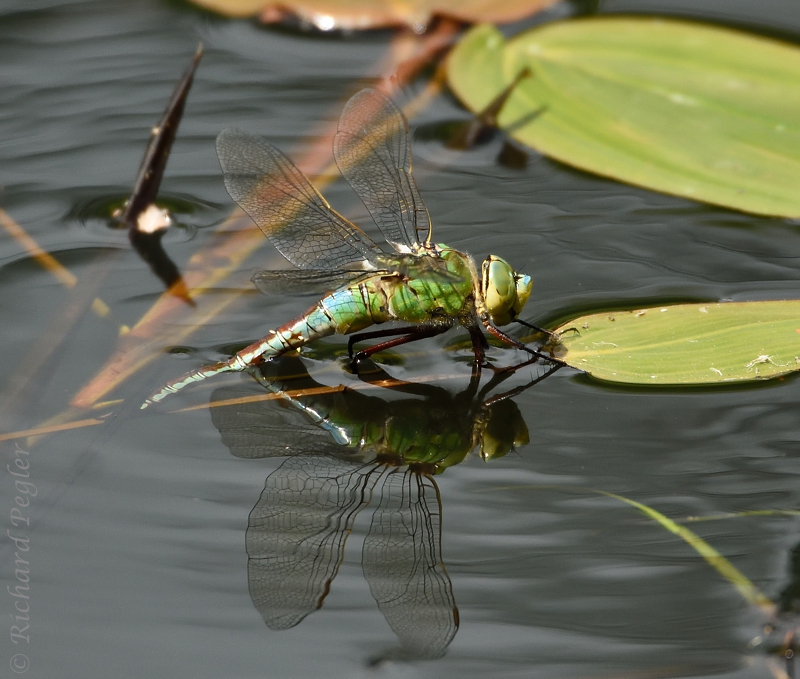
At least once a year, for the past eight years, I've had a holiday based at the wonderful Grant Arms in Grantown on Spey. Most of the time, including this time, I've been accompanied by my wife, Lindsay, who is very accommodating when it comes to my wildlife photography interests! This is the first part of my account of this June's holiday.
Friday, 9th June
We didn't get away until around 10h15 as I had last minute details, mainly concerned with sorting out the wildlife feeders in our garden for the duration of our absence, to take care of.
We had a relatively pleasant journey north on the M1, M18, and A1, stopping off at one of our favourite lunch venues - the Deli Cafe in Boston Spa - followed by a quick visit to one of the charity shops in that town.
We met with rather a lot off slow traffic as we headed further north, but still managed to hit Berwick upon Tweed at our target time of 16h00. Here we were greeted by Liz at the superb B&B which is Tweed View House. It was as we unpacked our luggage from the car that I realised that I'd managed to forget to put my walking shoes in the car before we set off - I'd only got casual shoes with me!
We'd been recommended The Collingwood Arms in Cornhill by Liz and Graham, and we managed to book a table for dinner there at short notice.
Lindsay had noticed a branch of of the outdoor pastimes emporium 'Go Outdoors' as we had entered Berwick that afternoon, and so we headed off there on our way to dinner. Within a couple of minutes of entering the shop, I'd managed to find a really comfortable pair of boots at a very reasonable price. They were £40 without a Go Outdoors card, but only £20 if you purchased a Go Outdoors card for £5 - no contest! I wore them all holiday (although Lindsay made me take them off at bed time!) and they were extremely comfortable and took me over some quite rugged terrain.
The meal at the Collingwood Arms was excellent. I had the Saumon en Papillote, followed by home-made ice cream, of which the Pimms ice cream was possibly the best ice cream I had ever tasted. I have since attempted to re-create the first dish with 80% success. The second will have to wait for a while.
On the way out to The Collingwood Arms I'd seen what I took to be a sign to a local nature reserve and, as it was a pleasant evening we decided to stop there on the way back. It turned out to be nothing of the sort, but the information board for a very historic bridge - claimed to be one of the most important examples of medieval bridges in the country. If you've got good eyesight and a high-resolution screen you should (just!) be able to read the description on the following image - if not, please look up Twizel Bridge on t'interweb!
 |
| Information Board - Twizel Bridge |
Lindsay and I took a walk across the bridge and around its immediate environs. I'd never seen Sycamore seed wings with such an attractive shade of red before.
 |
| Sycamore (Acer pseudoplatanus) (seed wings) - Twizel Bridge |
A pair of Pied Wagtail were feeding young and getting rich pickings from over the waters of the River Till that Twizel Bridge crosses.
 |
| Pied Wagtail (Motacilla alba) - Twizel Bridge |
We were both very tired that night and turned in early.
Disappointment of the day: realising I'd left my boots at home
Highlight of the day: dinner at The Collingwood Arms
Saturday, 10th June
After an excellent breakfast, brought to us in our room by Graham, we set off northwards again. The journey tends not to be very exciting until after Perth, although the initial part along the coast can be quite pleasant when it's not raining - but it was!
It was still raining when we reached Perth, and we stopped at the Macmillan Coffee Shop near Scone Palace for tea and cake as we would otherwise have been too early at our next planned stop. This establishment is run to very professional standards by volunteers in support of the well-known cancer charity. The cakes are wonderful!!!
The rain had diminished to drizzle by the time we left, so we had a quick look at the burn to see if we could spot Dipper - we couldn't.
Twenty minutes later we were in the outskirts of Blairgowrie and at the Dalmore Inn. This is our favourite lunch stop anywhere, and we have never been in the least bit disappointed here. After a superb light lunch we were on our way again and heading towards Braemar.
We usually stop at the Glenshee Ski Area as this is sometimes a good place for good views of Ring Ouzel. This was not to be on this occasion, so we were soon on our way again.
We'd not gone far before I spotted a Ring Ouzel close to the road. I managed to find somewhere to stop about a couple of hundred metres further on, and had a steady wander back. I must have been only about a hundred metres away when I saw the bird fly up from the grass by the road and disappear way up the mountain side. I wandered back towards the car and noticed a Dipper way down in the Clunie Water (river) below me.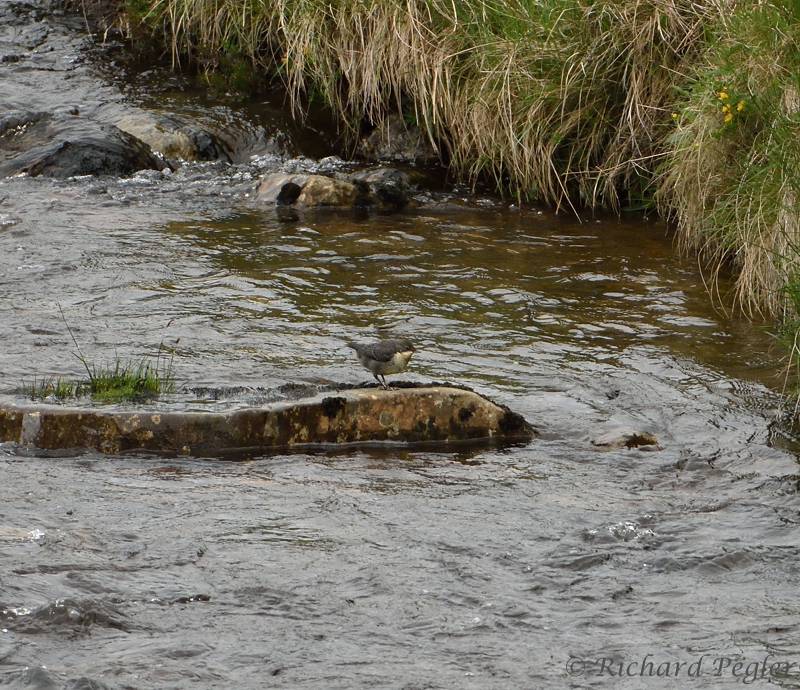 |
| Dipper (Cinclus cinclus) (juvenile) - north of Glenshee ski area |
I was busy trying to photograph this juvenile bird when an adult suddenly appeared and sent the juvenile away upstream. |
| Dipper (Cinclus cinclus) - north of Glenshee ski area |
Two years ago, on a visit to Speyside with friends David and Miriam, we struggled to find Dipper, so these two birds at the outset were a welcome find.Beyond Braemar, in the environs of Balmoral Castle, we take the B976 (a single-track road with passing places) which crosses the moors. We'd only been a short while on this road when a vehicle came rushing up behind us, so I pulled into the first passing place to let it overtake. This gave us our first sighting of the holiday of Red Squirrel. |
| Red Squirrel (Sciurus vulgaris) - near Crathie |
Beyond Braemar the rain stopped, the sun had started shining, and it was getting much warmer, so the last part of our journey was far more pleasant.
Last year on our journey to Speyside, Lindsay spotted a pair of Woodcock at a place near Ballater. There were a pair there on our return journey too, so this year I was prepared. I parked the car and there was birdsong all round. No Woodcock was seen but I didn't want to come away entirely empty-handed. |
| Grey Wagtail (Motacilla cinerea) - near Ballater |
 |
| Song Thrush (Turdus philomelos) - near Ballater |
This skull, placed in a prominent position near the road, was a macabre sight. I suspect it might be from a ram. |
| Skull - near Ballater |
We arrived at the excellent Grant Arms in Grantown on Spey at around 16h30, and were informed at check-in that whilst dinner started at 18h30, they'd allocated us a 19h30 slot as they had a large party booked for dinner at 18h30. We weren't going to argue with that decision!
As we'd time to kill before dinner, and the sun was shining brightly, we decided that unpacking would wait until after dinner and that Lochindorb was calling us. Lochindorb is one of our favourite places, and it didn't let us down this time.
The usual summer group of nesting Common Gull was beside the approach road with their lookouts up on the fence.
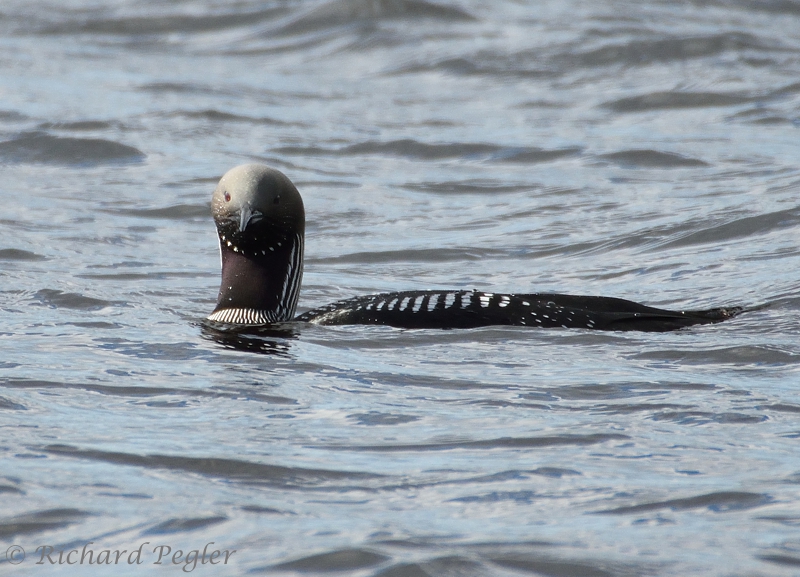
As we took the lochside road there was a Redshank only about 2 metres from the road edge, opposite a passing point, which I pulled into. Sadly, the vehicle following me thought I was pulling in for his benefit, and tooted his thanks loudly, sending the bird flying!In the event, this turned out to have done us a favour. It meant that, when we found a Black-throated Diver close to the road, just a little further along, we could stop without hindrance.  |
| Black-throated Diver (Gavia arctica) - Lochindorb |
Even though the light was behind the bird, I managed some images that I'm delighted with, and are my best-ever of this species. One of the beauties of photography is that it can allow one to see what might otherwise pass unnoticed. For example, I'd never noticed until then that this diver's 'black throat' is, in fact, a very dark purple. I'd also never noticed the lines of very small water droplets that seem to gather on the grey part of the head, behind the eyes. |
| Black-throated Diver (Gavia arctica) - Lochindorb |
Having taken a few shots, we continued on our way, to leave the diver to its wanderings. Beyond Lochindorb Lodge, a distant Redshank (possibly the one seen earlier) was perched on a rock. |
| Redshank (Tringa totanus) - Lochindorb |
We carried on to the end of the road, turned round, and made our way back again. Whilst the usual Red Grouse were not being seen in any numbers, we did see a few chicks of that species which seemed to have strayed from their parents. |
| Red Grouse (Lagopus lagopus scotica) (chick) - Lochindorb |
After an excellent dinner at the Grant Arms, it was time to unpack and then have an early night again.Highlight of the day: the Black-throated DiverSunday, 11th June On Tuesday 13th, I was booked to lead a small group of people to view a couple of dragonfly ponds where relatively rare species can be found so, not having been to these places for a year, I thought I'd better visit to check that disaster hadn't struck either of the two sites in the interim. After a good breakfast the weather was not so bright so, to give it time to warm up a bit, we set off for a place near Nethybridge which can be good for Short-eared Owl.As we arrived, Lindsay spotted an owl departing the area. We parked up and I missed the low approach of an owl behind us. By the time I took a shot, it was well past us. The owls tend to travel low to their hunting grounds, and return high with prey, so we sat and waited. One never knows what might show up here - sitting in this exact same spot (which will just take one car) I've seen Long-eared Owl, Tawny Owl, White-tailed Eagle, and Capercaillie (!) - plus many other interesting birds.This area is also good for Curlew, so I took a few shots of these while I waited. |
| Curlew (Numenius arquata) - near Nethybridge |
Eventually a Short-eared Owl passed by, flying very high and with prey. This poor shot was the best I could do. |
| Short-eared Owl (Asio flammeus) - near Nethybridge |
As the weather was brightening up, we headed for the dragonfly 'ponds', both of which are in the Boat of Garten area.As we arrived at the first location, which is good for Northern Damselfly, it was still a bit dull, and rather windy, and I did not have high hopes for success. I was, therefore, delighted to find three male specimens roosted just about within reach of my lens. It helped that the sun wasn't shining as, with their wings held close to the body, there were no confusing shadows. It didn't help at all, however, that the stems were swinging through about 6 inches (15 cm) while I was trying to fix on them! |
| Northern Damselfly (Coenagrion hastulatum) (male) - near Boat of Garten |
A couple of Blue-tailed Damselflies appeared when it brightened up for a few moments. |
| Blue-tailed Damselfly (Ischnura elegans) (male) - near Boat of Garten |
Lindsay has eagle-eyes which possibly rival those of our dear friend Miriam. She spotted this Common Lizard hiding on a tuft which was surrounded by water. This is probably the largest specimen of the species that I have ever seen. I believe that this was a female laden with eggs, and she seems to be growing a new tail. |
| Common Lizard (Lacerta vivipara) (female) - near Boat of Garten |
Also here, I spotted a very small, but brilliantly coloured, beetle which I believe to be Plateumaris discolor.  |
| Beetle (Plateumaris discolor?) - near Boat of Garten |
The weather seemed to be picking up further, so we set off for the second location, which is a tiny pond which attracts White-faced darters. However, unless you are lucky enough to find one roosting in a tree, you are unlikely to spot one in dull weather as they only seem to show when the sun is shining. It wasn't shining when we arrived!I stood there patiently for some time and eventually the sun broke through. In less than a minute a White-faced Darter was there, and settled on the boardwalk about 5 metres from where I was standing. Also, what I believe to be an ovipositing female was seen at around 10 metres distance at the same time. I took a few distant safety shots of the male, the sun went in, and both disappeared. |
| White-faced Darter (Leucorrhinia dubia) (male) - near Loch Garten |
As these had gone, I was able to move my attention to the Large Red Damselfly that had landed at my feet and chose to stay there after the sun went in! |
| Large Red Damselfly (Pyrrhosoma nymphula) (male) - near Loch Garten |
I waited for some time in the hope for more sun, but it got cloudier and then started to rain - time to go!Our next stop was at the base station of the Cairngorm Mountain Railway. This is often a good spot for Ring Ouzel. I started by looking in the gardens just above the station, but found nothing so wandered up the path that runs beside the burn. As it started to rain again, I headed back down again after about 15 minutes. I then noticed a couple of people with binoculars down below the base station who had obviously found something. I joined them and, after a few minutes, a juvenile Ring Ouzel flew into view and landed on a very non-photogenic rope! |
| Ring Ouzel (Turdus torquatus) (juvenile) - by Cairngorm Base Station |
It flew off again almost immediately and was lost from view. By now, our numbers had swelled to six and when an adult male appeared it kept its distance. Then another appeared - and then a third! All the while they were distant, and the photos didn't amount to much. Eventually everyone else disappeared and I stood there quietly waiting. Soon my patience was rewarded and I got some reasonable shots - although I have had much better in the past. |
| Ring Ouzel (Turdus torquatus) (male) - by Cairngorm Base Station |
Lindsay had stayed in the car as it was rather cold and windy here, so I returned to her and we set off on our travels again. Lindsay was in need of sustenance, so we called in at The Potting Shed, near Aviemore, which is claimed by some to be one of Britain's best cake shops - I'm not about to argue with that! In addition to the delicious cakes, one of the rooms has a very long window with a shelf (a bit like that in a bird hide) to place one's tea and cake on so that you can enjoy refreshment whilst looking at the birds and squirrels on the feeders outside the window. There's seating at the window for about 20 people, but you might have to queue for a place!
 |
| Red Squirrel (Sciurus vulgaris) - The Potting Shed, near Aviemore |
Somewhat replete, we headed off to Glenfeshie. We saw little on our drive and my attempt to photograph a juvenile Stonechat came to nothing as I'd still got the camera set for the very low light outside the window of The Potting Shed.
Next stop was at Avielochan, where residents at the Grant Arms have exclusive access to the hide there. As I was booked to look after a group there on the Thursday morning, this was another checking-out visit. There were some interesting birds around, but none were playing ball. A lone Slavonian Grebe was the only bird to come within sensible range of the camera.
 |
| Slavonian Grebe (Podiceps auritus) - Avielochan |
Our last location before returning for dinner was on the road that leads to the old Inverallan Cemetery by Grantown. A visit to the cemetery produced a couple of Oystercatchers, and a Pied Wagtail feeding a juvenile. 
 |
| Oystercatcher (Haematopus ostralegus) - Inverallan Cemetery |
 |
| Pied Wagtail (Motacilla alba) - Inverallan Cemetery |
Outside the cemetery, a Black-headed Gull was drawing our attention to a sign.
 |
| Black-headed Gull (Chroicocephalus ridibundus) - by Inverallan Cemetery |
A little further downstream a pair of Red-breasted Merganser, which I originally took to be Goosander, were resting on a small island.
 |
| Red-breasted Merganser (Mergus Serrator) (female + male) - River Spey at Grantown |
Just a few metres downstream was a drake Goosander, which was showing well just to add to the confusion.
 |
| Goosander (Mergus mergus) (male) - River Spey at Grantown |
After an excellent dinner that evening, Lindsay settled for a night in whilst I decided on a trip to my owl location near Nethybridge.
I didn't fare any better with the owls than on my previous visit - here's one which will give a clue to the difficulties.
 |
| Short-eared Owl (Asio flammeus) - near Nethybridge |
I did manage a few more shots of Curlew.
 |
| Curlew (Numenius arquata) - near Nethybridge |
Highlight of the day: It's a toss-up between the Ring Ouzel and the Northern Damselfly
Monday, 12th June
A relatively gentle day was in order for to day as I was booked to give the first ever delivery of my talk 'I'm a Bit of a BUG-er' to the Bird Watching & Wildlife Club at the Grant Arms that evening.
Lindsay and I set off for Strathdearn, otherwise known as The Findhorn Valley, otherwise known as The Valley of the Raptors. This is a scenic run up a single-track road after Tomatin. In the past, I have, invariably, found the journey more rewarding than the destination, but that's probably just my point of view.
The weather was windy, with plenty of rain from the outset, so expectations were low. On the way we stopped to photograph a Spotted Flycatcher, just before we got to Garbole. It was where a Woodchat Shrike had been up to four days earlier, but had not been seen since.
 |
| Spotted Flycatcher (Muscicapa striata) - near Garbole |
Further along, by Glenmazeran, there's a bridge that we usually stop at as there's an off-road parking space. Lindsay's eagle-eyes spotted a Dipper, which made its way towards us. I took a number of photos as it went to various boulders around the bridge, and then the penny dropped. It still had the same food in its bill, and was probably waiting for us to disappear before taking food to its young under the bridge - we departed immediately.
 |
| Dipper (Cinclus cinclus) - Strathdearn |
We stopped at the end of the road, and had a picnic lunch, but it threw it down with rain the whole time we were there, and nothing of interest was seen. Eventually we gave up and headed back.
At one point there is a wall which, for some reason, is favoured by Oystercatchers. There were two, as we headed past. Here's one of them.
 |
| Oystercatcher (Haematopus ostralegus) - Strathdearn |
We headed towards Aviemore as I fancied a visit to the nature reserve at Craigellachie, and Lindsay had volunteered to wait in the car and do a crossword! I was hoping to see the Pied Flycatchers that I had seen the previous year.
As I entered the sight, I took a shot of a Jackdaw.
 |
| Jackdaw (Corvus monedula) - Craigellachie NR |
I stood on the path at a respectable distance from where the flycatchers had been the previous year (further away than the guide had taken his clients to on that occasion) and waited. I saw Spotted Flycatcher and Treecreeper and a number of other birds, but no Pied Flycatcher.
 |
| Treecreeper (Certhia familiaris) - Craigellachie NR |
 |
| Spotted Flycatcher (Muscicapa striata) - Craigellachie NR |
As I was debating whether to depart, a wildlife guide arrived with a group of Americans. He kindly gave me directions as to where there was a possibility of finding the Pied Flycatchers. After about three quarters of an hour, I was starting to wonder how much further it was. Whether I'd passed the place, or hadn't gone far enough I'll never know. It had now got warm and sunny, I was overheating going up-hill in my wet-weather gear, and it had now reached the time that I told Lindsay that I'd be back to her. Fortunately my phone found a signal and I phoned Lindsay to offer my apologies, after which I turned back!
I stopped a couple of times to rest on my way downhill, once stopping to photograph a beetle. On a previous occasion in Scotland I'd accidentally turned over a beetle when trying to move it a few inches into some sunlight. I'd been amazed at what I saw. This was a much smaller beetle, and some soil stuck to it when I turned it over, but you can get the idea of what I'm talking about!
 |
| Woodland Dor Beetle (Anoplotrupes stercorosus) - Craigellachie NR |
Please don't worry about the beetle - it righted itself in two or three seconds. Thank you, Adrian, for the ID!
Further down I photographed a couple of flowers in the woods. The first one is, I believe, Bugle. The second seems to be a very pale example of a Common Spotted Orchid.
 |
| Bugle (Ajuga reptans) - Craigellachie NR |
 |
| Common Spotted Orchid (Dactylorhiza fuchsii) - Craigellachie NR |
Suitably penitent I returned to Lindsay, less than an hour late. I was pretty-much worn out - not good when I needed to be alert that evening.
As it was a little early for returning to the hotel, we took the long route back, via Lochindorb. No wildlife was photographed, however.
Refreshed, to a degree, by a good dinner, I set up for my talk that night. I only had a small audience as the hotel was full of general tourists, with very few birdwatchers that weren't out with guides for the evening - competing for customers with Alan Davies and Ruth Miller was never going to be easy. I'm pleased to say that the audience were very kind in their show of appreciation, and there were useful discussions at the end.
Highlight of the day: The Dipper
I'll shortly start working on Part 2 of my report on our holiday, but I might just throw in a short blog post on another subject in the interim.
Thank you for dropping by.



 On 16th June, I joined an arranged visit to Yardley Chase, which was organised by Mark Tyrrell, County Dragonfly Recorder for Northamptonshire, on behalf of the British Dragonfly Society. The objective of the visit was to observe Downy Emerald dragonflies at Northamptonshire's only site for this species - and also to see what else was around!