Leaderboard
728x15
Showing posts with label Tit Great. Show all posts

Oakthorpe Colliery - on 16th January, 2018

For various reasons, I've done virtually no birdwatching for the past couple of weeks, other than observe the birds in my garden during foul weather. However, I thought I'd better do a blog post, just 'to keep the pot boiling'. So here goes -

Approximately 1 mile (1.5 km) from my home is the site of the old Oakthorpe Colliery. This has been transformed into something of a wildlife haven, although I was concerned recently that people were shooting next to the car park. Up until very recently there have been bird feeding stations at each end of the car park. However, I found when I visited on 16th January that the station at the north end of the car park had been dismantled and a new station installed only a few metres from the station in the south-west corner of the car park. I'm not sure of the reason for this move, but it seems to have had an effect on what species are visiting the feeders. 

I had to bide my time for a while in a rather awkward position for photography as a car had parked right beside the new feeding station and the occupants gone off for a walk. After about an hour they returned and departed in their car and I was able to move my car, which I used as a hide, into a more favourable position. 

In its previous position, the feeding station used to regularly attract Jay, Great Spotted Woodpecker,  Nuthatch, and the occasional Willow Tit (a bit scarce in these parts these days). However, on this occasion, the first three of these species only made nervous approaches without stopping to feed, and Willow Tit was not seen at all. Hopefully this will change when the birds get used to the new set-up.

It was good to see a Yellowhammer approach the feeders, although it didn't stop to feed. This used to be a regular at this site in winter, although I hadn't seen one here for some time and wondered if they'd gone.

The weather and light were not great, but here are some images from that session. I hope you like Tits!


Blue Tit (Cyanistes caeruleus) - Oakthorpe Colliery

Coal Tit (Periparus ater) - Oakthorpe Colliery


Great Tit (Parus major) - Oakthorpe Colliery

Long-tailed Tit (Aegithalos caudatus) - Oakthorpe Colliery
The Woodpecker stayed well-hidden. I think that it realised I was there!

Great Spotted Woodpecker (Dendrocopos major) (male) - Oakthorpe Colliery
 Sadly, the Yellowhammer stayed distant and partly obscured by a branch, but I was pleased to get any sort of shot of this bird.


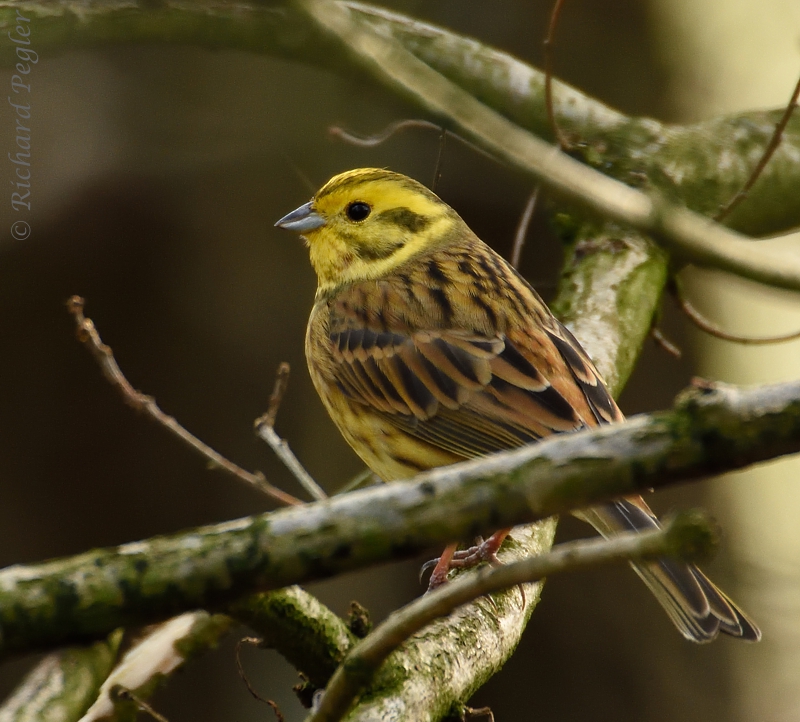
Yellowhammer (Emberiza citrinella) (male) - Oakthorpe Colliery
I know that some birders are not too fond of Grey Squirrels, but I consider them to be charming creatures - it's not their fault that someone decided to introduce them into UK!


Grey Squirrel (Sciurus carolinensis) - Oakthorpe Colliery
 
2018, Week 03 - 15th to 21st January
Garden List - Week 03 - 15/01/2018 to 21/01/2018 

It was a quite interesting week in the garden, no doubt helped by the fall of snow we had. The total number of species setting foot down increased from the 22 of the previous two weeks and reached 24 species.

Jackdaw put in a brief appearance once again, and I just managed to spot a Redwing in our Rowan before it departed. A male Siskin has also been visiting on some days - I hope that he attracts a female!

The male Sparrowhawk has started making a nuisance of himself again. He's not catching much at all, but causing the birds to flee in panic, sometimes flying into the window glass. Usually I manage to rescue them, but I did have a male Chaffinch break its neck today.

In a few days time I shall be away in Scotland (a solo visit) for a week , so I am not sure what or when my next post will be.


Boxing Day - 26th December, 2017

Lindsay and I usually have a picnic lunch in the countryside at some time round Christmas Day. This was, for a number of years, on Christmas Day itself. However, for the past two years we have been invited to our daughter Melanie's house for Christmas lunch, so have had our picnic on Christmas Eve. This year Melanie wanted to do things differently with the main meal on Christmas Eve, and a buffet lunch on Christmas Day. Lindsay and I, therefore, postponed our picnic to Boxing Day lunch.

Lindsay requested that we go to Cannock Chase as she hadn't been there so far this year.  It's a place we are both fond of and it can, occasionally, throw up some interesting birds. The day dawned mild and sunny and I was concerned that the place might be a little busy. However it was even busier than we feared! On arrival at the car park there was just one space available and it was furthest from the bird action. We persevered for a while, attacking our picnic lunch. Eventually a space became free near to where the birds were feeding, but we both had a very limited field of view, and that was mainly through the car windscreen, and there were so many people around that the more interesting birds were staying away. It was just the more common tits plus Dunnocks and Chaffinches, and the occasional Bullfinch and Nuthatch, to keep us amused, and a solitary sighting of a Willow Tit to cause excitement. There was only one place I could get any sort of photo if a bird landed there - and that wasn't ideal for light or background. I took shots of several species in exactly the same position, so will only offer one:-

Great Tit (Parus major) - Cannock Chase
I even tried taking some shots through the windscreen, but this is never satisfactory. I just about managed a Robin!

Robin (Erithacus rubecula)  - Cannock Chase
We weren't there for long before we decided to give up and head off for a mug of tea at Springslade Lodge. Lindsay had been hoping to see some deer, but we'd come to the conclusion that there were so many people wandering around that we didn't stand a chance. However. we'd only got a couple of hundred metres from our parking spot when Lindsay spotted one in the trees beside the road.

Roe Deer (Capreolus capreolus) (female) - Cannock Chase
When we arrived at Springslade Lodge we found the place was packed and we had to wait a while and take a seat outside on the terrace to drink our tea. It was then time to head homeward.

In the past, Whitemoor Haye has been a good place for birds, with a large swan roost each winter which regularly turns up Whoopers and Bewicks, and has also been good for Corn Bunting. I'd not been there this year so we made a small diversion to check it out. I was quite upset to see the whole area has undergone massive earthworks, but can find no information as to what these pertain. We continued a circular drive round, seeing only four Mute Swans and little in the way of passerines. We then turned a corner and I immediately spotted a Buzzard in the hedge on my side of the single-track road. I slewed the car round at around 30° across the road, turned off the engine and took a shot, expecting the bird to do the usual thing of taking off as soon as I poked my lens out of the window - it did no such thing!

I started the car again and moved a little closer and took more shots. It didn't budge!

Common Buzzard (Buteo buteo) (juvenile) - Whitemoor Haye
I started the car once more and edged a little closer. I was probably less than 10 metres away now, and still it stayed.


Common Buzzard (Buteo buteo) (juvenile) - Whitemoor Haye
I felt sure it would go when I started the car yet again, and got the distance down to  around six metres - but it didn't!

Common Buzzard (Buteo buteo) (juvenile) - Whitemoor Haye
Unbelievably it stayed there when I again started the car and stopped opposite it, probably at less than 4 metres distance. It was only when it saw my amazed face looking at it that it lazily took to the air and departed. I suspect that I'll never get as close to a wild Buzzard as this ever again, and that I only had this privilege because it was a juvenile. Here's a shot of it departing.

Common Buzzard (Buteo buteo) (juvenile) - Whitemoor Haye
When I came to check my camera I was worried to see that I was still set up for shooting in the shade of woodland. My shots had been taken at an unnecessarily high ISO value (800) and consequently at a rather high shutter speed (1/5000s). My set-up does not usually work well at high shutter speeds (I don't know why!), but I seem to have got away with it, and it will have helped with that last shot. I do, however, think I'd have done better shooting at ISO 200 for those static shots.

Closer to home we stopped in the car park a Oakthorpe Colliery as it was probably years since Lindsay had been there. On this occasion there were only common birds coming to the feeders, and the Willow Tits were not seen. Here's a couple from that session.

Blue Tit (Cyanistes caeruleus) - Oakthorpe Colliery
Coal Tit (Periparus ater) - Oakthorpe Colliery
After this it was a five minute journey to our home. We'd had a most enjoyable day, even if only common birds had been seen, but the Buzzard had been a real bonus. We did, however, make a mental note not to go anywhere quite so 'public' on Boxing Day next year, especially if the weather is fine!

I take this opportunity to wish my readers A VERY HAPPY NEW YEAR! If you are making New Year resolutions, please include a commitment to work towards making this planet a better place, particularly for its wildlife - it's time we all made amends for past abuse.

Thank you for dropping by.

Mandarin - on 7th May, 2016

I'd had rather a stressful 24 hours, and it was warm with a fair bit of sunshine so, mid-afternoon, I decided to go out for a couple of hours or so and connect with the natural world.

My plan was to see if I could find Large Red Damselfly locally. I'd seen my first one of the year at Rutland Water two days previously, but only for a couple of seconds and didn't manage any photos. I was hoping that the wetland area by the north hide at Calke Park might be a suitable area. It was then my intention to visit another area of the park where I'd got a couple of Little Owl sites plus, last year, a breeding pair of Mandarin Duck (3 chicks raised).

I didn't see any sign of Large Red Damselfly by the hide, so decided to pop into the hide in the hope of getting some photos of Marsh Tit. I saw a Marsh Tit when I first arrived, but not anywhere where I could photograph it. Whilst I waited I took a few photos of other, more common, tit species. 

Great Tit (Parus major) - Calke Park
Coal Tit (Parus ater) - Calke Park
Blue Tit (Parus caeruleus) - Calke Park
I was on the point of moving on to my next location when, out of the corner of my eye, I noticed what looked like a duck fly into the trees beside the hide. I scanned with my binoculars and eventually located it about 20 metres away - rather well hidden! It was a male Mandarin! This is what I saw.

Mandarin Duck (Aix galericulata) (male) - Calke Park
Fortunately, I was on my own in the hide and so could move about freely. From a window at the further end of the hide I had a slightly better view.

Mandarin Duck (Aix galericulata) (male) - Calke Park
Whilst this is not a rare duck, I rarely see one in the Midlands, and would not call it common. As an introduced species which has become naturalised, it is looked upon less than favourably by some people. However, I've never succeeded in getting any images of one that I'm anywhere near satisfied with. I was, therefore, somewhat frustrated at having this bird only about 20 metres away but almost totally obscured by trees. I left the hide and after a little careful exploration found a place with a somewhat clearer view.

Mandarin Duck (Aix galericulata) (male) - Calke Park
I returned to the hide and sat and awaited the bird's next move. At one point I let my attention drift, then turned round to look at the bird again, only to find it had gone. Having tried to relocate it for a while, without success, I was on the verge of departing once again when suddenly the bird poked its head out of the ground vegetation only about 10 metres in front of me for a few seconds before ducking back in again. Both frames I took were soft focus because of intervening vegetation. The next thing I knew was that a female Mandarin was emerging from the same spot and making her way towards me.

Mandarin Duck (Aix galericulata) (female) - Calke Park
She was shortly followed by the male.

Mandarin Duck (Aix galericulata) (male) - Calke Park
At no time were the two birds close enough together for me to get a sensible shot of them both. This was the nearest I could get to that!

Mandarin Duck (Aix galericulata) (male + female (just!)) - Calke Park
I'm relatively sure, now, that the male poking his head out and then ducking (is that where the expression comes from?) back in was him checking out that all was safe for the female. The female continued forward and fed from the ground at around 4 to 6 metres in front of me. The male remained at around 8 metres distance, constantly keeping a watchful eye, and not feeding. It seemed like this went on for over half an hour but I see, from the camera data, that this close encounter only lasted 14 minutes.

I spent most of the time photographing the male. He looked relatively immaculate. The female, however, soon had a mess of stuff stuck to the left hand side of her bill. She was also a bit too close! For the male I had to wind the lens back to between 340 and 420 mm. For the female I was looking down on her most of the time and had the lens at between 240 and 340 mm.

Here's a few more shots of the female.


Mandarin Duck (Aix galericulata) (female) - Calke Park
I make no apologies for rather a lot of images of the male bird. I'm never likely to get this close again, and it is the most spectacular duck that I've ever seen. I was able to fully appreciate the fabulous palette of colours on the top of the head and that wonderful mauve colour on the front of the neck and upper breast area. The physical configuration of the feathering is also out of this world - a truly amazing duck!


Mandarin Duck (Aix galericulata) (male) - Calke Park
Sadly, my head was still elsewhere for much of the time and most of those images could have been somewhat better with more appropriate camera settings.

Suddenly, without warning, they took off in unison. I hung around for a little longer, but the most exciting thing that happened was a Great Spotted Woodpecker coming to within about 10 metres of the hide and departing again.

Great Spotted Woodpecker (Dendrocopos major) - Calke Park
I never did get round to visiting the other part of the park that day. Half my objective had already been achieved - big-time, and a visit to the Little Owls will wait!

I am conscious that I've not posted about owls for a while now, and I suspect that is the way it will continue for a bit. The owl situation has been extremely disappointing and, sadly, I've little to show or talk about on that subject.

I expect my next post will be a fond farewell to some of our winter visitors.

Thank you for dropping by.
Leaderboard